Free Crochet Sweater Patterns: 18 Easy Picks
- In this guide:
- Why free crochet sweater patterns are friendlier than they look
- Yarn, hook and gauge first
- Color palettes that always work
- Cardigan, pullover or jumper: know what you are making
- Styling and fit
- The 18 free crochet sweater patterns, sorted by difficulty
- Adapting a pattern to your size or your yarn
- Finishing, blocking and the fixes that matter
- The free printable kit
- Questions readers ask most
- Where to start
Why free crochet sweater patterns are friendlier than they look
Sweater crochet has the reputation of being the step right before professional, and most free crochet sweater patterns aimed at beginners are nothing like that. A pullover is a rectangle, two sleeves and a neck opening, and you already know how to do all three after a few practice rows. Below are 18 free crochet sweater patterns sorted by real difficulty, with honest notes on time, yarn and the mistakes that trip people up.
Start in the first group if you have never finished a garment, and skip ahead if a scarf with sleeves is already behind you. There is a printable kit at the end too, with palettes, a shopping list, a stitch cheat sheet and a gauge worksheet, so you can print one page and begin today. If your basics are still shaky, our crochet patterns for beginners guide covers the stitches that show up in nearly every one of these designs.
Crochet uses one continuous thread and one hook, so there is nothing to drop and unpick (what crochet actually is). That one fact shapes how sweaters get built. Most are worked flat, panel by panel, then sewn, because flat work lets you watch every edge and fix a mistake without unpicking a spiral. It is why the free crochet sweater patterns in this round-up feel calmer than their photos suggest.
Armholes look complicated and usually are not. In most designs it is one sentence: skip a set number of stitches, join the ends, keep working. Collars and cuffs tend to be a few rows of ribbing. Set-in sleeves and shaped waists exist, and plenty of good free crochet sweater patterns still use a dropped shoulder instead, which needs no shoulder shaping at all.
Free printable, instant download
Free Crochet Sweater Patterns: 18 Easy Picks
- Colour palette card
- Shopping list
- Stitch cheat sheet (US and UK)
- Row counter and project tracker
Yarn, hook and gauge first
Weight comes before color. The yarn weight system label tells you how thick a strand is before you commit to a project. Worsted and DK weights forgive tension wobbles. Sport and lace do not, and they will show every loose round across an entire body panel. Most free crochet sweater patterns on Ravelry are written for those two middle weights.
Budget acrylic is the cheapest way to test a design you are unsure about, and nothing is wrong with using it for a first sweater. Cotton makes texture crisp. Wool blends feel warmer but want gentle washing. Skip mohair and brushed novelty yarn for now, because the halo lies about how much yarn the project eats and your gauge stops meaning anything.
Hook size comes from the yarn band, not from the pattern. Want a relaxed fit, go one size up and re-measure. Our basic stitch guide covers the six stitches behind most of the free crochet sweater patterns here, so start there if single and double crochet still feel shaky.
Color palettes that always work
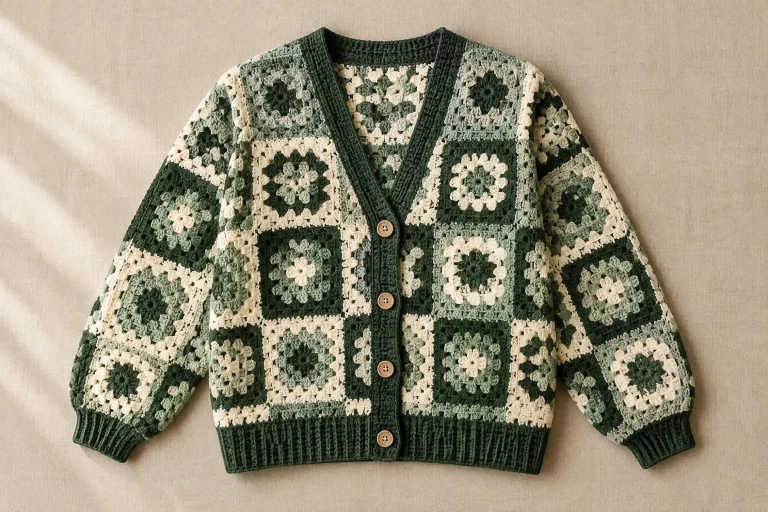
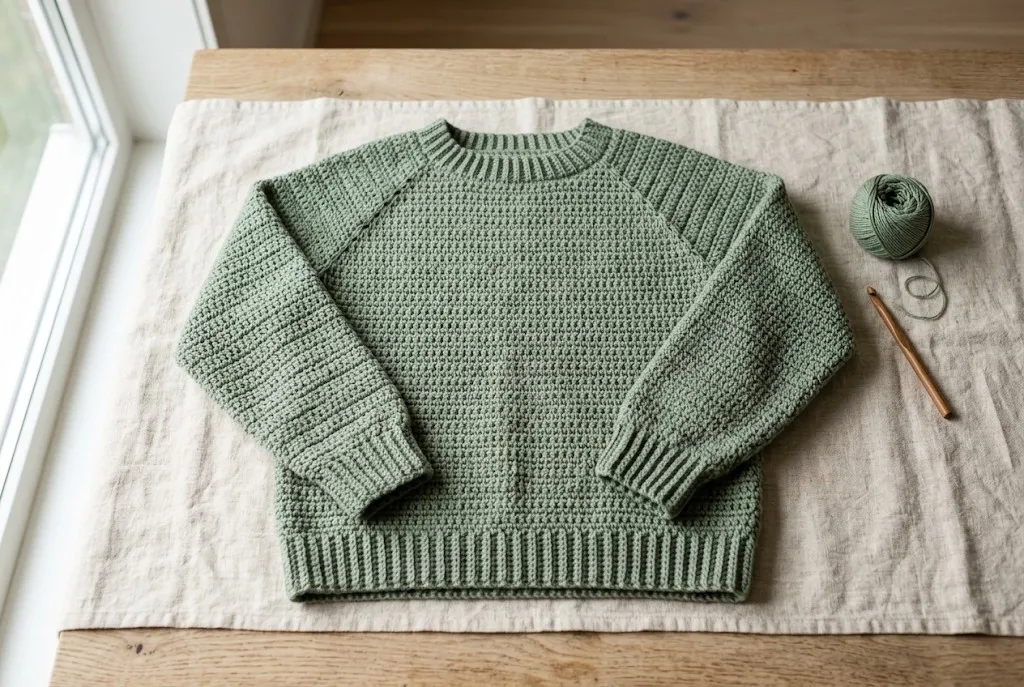
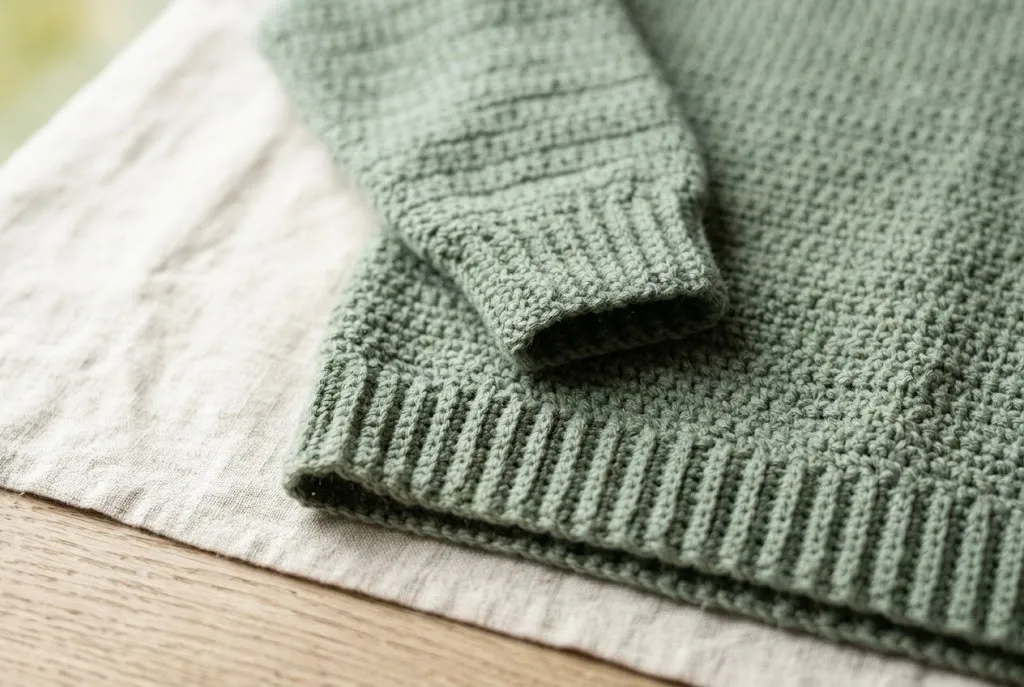
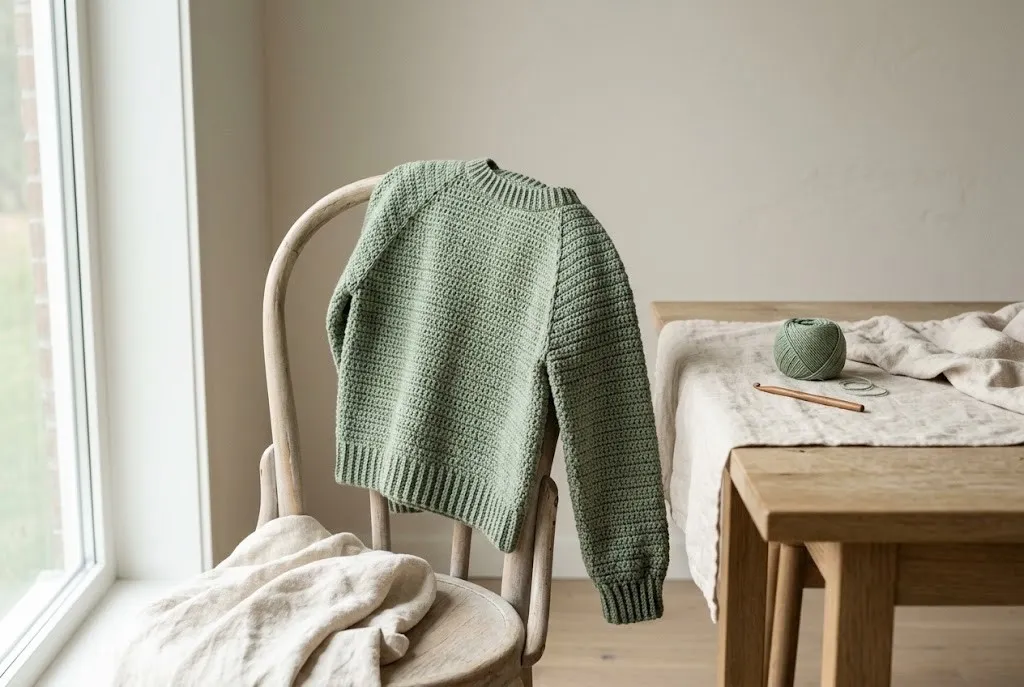
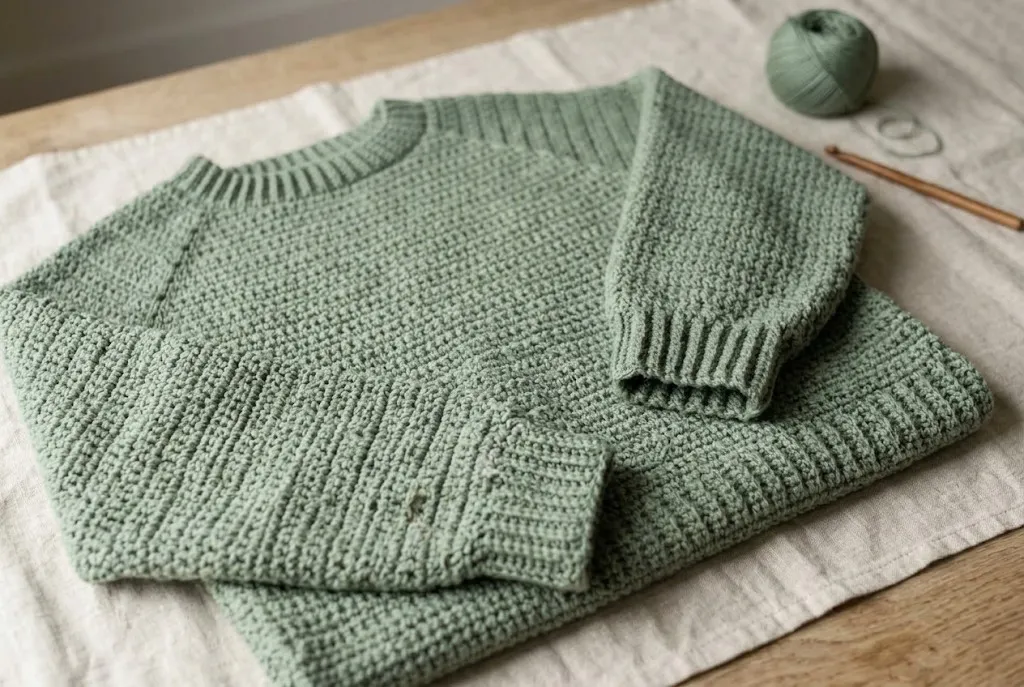
The sage green pullover on cream linen is the palette quietly everywhere this year, and it copies easily: one mid tone green plus a warm neutral. Muted greens also hide small irregularities, which is a fair trade on a first garment.
Three palettes do most of the work. Tonal uses three shades of one color. A contrast stripe breaks a neutral body with one bright skein. One color plus a neutral is the safest choice, and most of the free crochet sweater patterns in this round-up were designed with something close to it in mind.
Buy your main color first and the accent second. Two skeins of the same shade rarely match perfectly, and a small shift shows more on a big flat panel than you would expect.
Cardigan, pullover or jumper: know what you are making
US and UK vocabulary trips people up. In the US a sweater and a pullover both mean a pullover, a cardigan has a front opening, and jumper is barely used. In the UK a jumper is a pullover. Designers elsewhere use all three for the same garment, so read the first paragraph before you assume a pattern makes a cardigan. Search results for a crochet cardigan pattern free of cost are full of one-piece designs with no sizing at all.
For a first garment a pullover hides more mistakes, since a cardigan adds two front bands, a button row or ties, and extra finishing. If you want one anyway, start simple and buy the buttons before row one. Our patchwork cardigan guide covers how fronts get built, and it pairs well with the cardigan entries among these free crochet sweater patterns. A UK reader hunting a crochet jumper pattern free download is looking at the same garment under another name.
A sweater scarf with sleeves is the third option. No set-in sleeve, no button band, often a single skein, which makes it the fastest way to get the look of a sweater in an afternoon.
Styling and fit
Two numbers decide whether a sweater looks good on you: body length and sleeve length. Measure a sweater you already own, flat, shoulder seam to hem and shoulder to cuff. Write both down and hold them next to the finished panel. Building that habit before you start beats any technique tip.
A cropped body with a high rise is the easiest combination to wear, and a belt or wide waistband changes the read of a boxy pullover. Wide sleeves want a simple body. A textured body wants plain sleeves, because two competing textures in a hand-crocheted piece get busy fast. Getting this right matters as much as picking the right one of the free crochet sweater patterns below.
The 18 free crochet sweater patterns, sorted by difficulty
Straight answer first: we have not crocheted any of these eighteen designs. The level and time notes are reading guidance, based on the size range each listing offers, the yarn weight it calls for, and the construction the designer describes. The designer’s own notes win every time, so read them before you buy anything. Every link goes to the designer’s own page, where the pattern is free to read and download. Some listings ask for a free account or show ads.
Start here: crochet sweater patterns for beginners
Sweater for Newborns by Kelly Kearney is a tiny body with short rows, and the fastest route to a finished garment. Level: beginner. Estimate: 3 to 5 hours. Pitfall: check the size range, since newborn sizing runs out fast, and use the softest yarn you can find because skin rubs at the neck. Of all the free crochet sweater patterns here, this is the one to make first if you have never finished anything.
Eloise Baby Sweater by Tamara Kelly has the classic small sweater shape with a plain neck and simple sleeve, which makes it useful for learning how sleeve construction gets written down. Level: beginner. Estimate: 5 to 8 hours. Pitfall: baby sweaters often run narrow, so compare the finished chest with a cardigan your child already owns. The same checking habit works on any of the free crochet sweater patterns further down.
Sweater Paws and Stripes by Catherine Madjaric gets its stripes worked in at the end of a row, which makes this colorwork lookier than it is. Level: beginner. Estimate: 8 to 12 hours. Pitfall: carry the unused yarn loosely along the back, and check which stripes need a color change at a row end.
Sweater Keychain by Fay Lyth is a miniature sweater in a few strands, finished in under an hour, and the best confidence builder in the set. Level: beginner. Pitfall: use a tiny hook and count every round, because nothing hides a mistake at that size.
Sweater and Blanket (Sweater) by Mary Jane Protus is worked in blanket-weight yarn, so the fabric grows fast and the project finishes inside a weekend. Level: beginner. Estimate: 6 to 9 hours. Pitfall: follow the hook the designer recommends rather than the band on your own yarn, and expect a deliberately relaxed fit. Several of the free crochet sweater patterns here lean on bulky yarn for exactly that reason.
Sweater Wrap Scarf by Carrie M Chambers is a long rectangle with short sleeves, so there is no shaping at all. Level: beginner. Estimate: 5 to 8 hours. Pitfall: even the ends with a row of reverse single crochet before adding fringe, and block first.
Sweater Scarf with Sleeves by Jennifer Renaud drapes over the shoulders and skips the set-in sleeve entirely. Level: beginner. Estimate: 6 to 9 hours. Pitfall: buy one skein more than the listing says, because gradient repeats rarely line up where you need them.
Sweater Lupe by Las Varetas Crochet is a short-sleeve pullover in a light yarn for warm months. Level: beginner. Estimate: 7 to 10 hours. Pitfall: a cropped body needs an accurate gauge, because extra length throws the proportions off.
Confident beginner: you have finished a rectangle with sleeves
Boheme Sweater by Karmen Režek is a boxy pullover built from simple shapes, and one of the most reliable free crochet sweater patterns for a first adult sweater. Level: comfortable beginner. Estimate: 12 to 18 hours. Pitfall: check whether the body is worked in panels or in one piece, and buy the full yardage for your size, because a relaxed fit eats yarn.
Sweater by Wannipa Yunker is a full-length pullover in a standard weight yarn, listed across a range of sizes. Level: comfortable beginner. Estimate: 14 to 20 hours at the middle size. Pitfall: read the layout notes before you cast on, because a pattern written as one piece changes the order of your rows completely.
Sweater, All One Piece by Amanda Paz has no seams at all, so it is worked in a continuous spiral from the hem up. Level: comfortable beginner. Estimate: 10 to 15 hours. Pitfall: a stitch marker at the start of every round is not optional here, and the neck opening is where people miscount.
Sweater Hojas by Paula Santana is a textured design built on a leaf-like stitch, worked as flat panels with a join. Level: comfortable beginner. Estimate: 15 to 22 hours. Pitfall: textured stitches eat yarn and read differently depending on whether you alternate rows, so make a swatch, wash it and look at it in side light. It sits at the harder end of the free crochet sweater patterns in this tier.
Sweater #LM0125 by Denise Black has a fitted look and a real size range. Level: comfortable beginner. Estimate: 12 to 18 hours. Pitfall: find out whether the sleeves are worked flat or picked up from the body, and check the armhole depth against a sweater you own, since shallow armholes are the most common reason a first sweater feels tight.
Sweater by Karen Andersen is a straightforward pullover that works well as a first adult project. Level: comfortable beginner. Estimate: 10 to 16 hours. Pitfall: confirm whether the neckline is split and worked flat or joined from a band, because the two count stitches differently.
Sweater Weather Cardi by Toni Lipsey is a long cardigan with front bands and closure details, so there is more finishing than a pullover. Level: comfortable beginner heading toward intermediate. Estimate: 16 to 24 hours. Pitfall: both front bands have to match in length, so measure them before the button row and pick your buttons first.
Take your time: shaping, texture and bigger projects
Sweater Hoodie by Wannipa Yunker has a hood, and a hood usually means shaped sections or stitches picked up from the neck. Level: intermediate. Estimate: 20 to 30 hours. Pitfall: a miscount in the neck shaping is painful to undo, so practice the neckline on a swatch first.
Sweater 2 by Catherine Iannuzzo is a shaped garment where the waist change depends on placed increases and decreases, which only works if your gauge is honest. Level: intermediate. Estimate: 18 to 26 hours. Pitfall: block each panel to the stated measurements and pin it, rather than eyeballing the seam.
Sweater Miss Manga by Le Crochet d’Argent works motif panels with color changes, so the fabric has to be even before anything else matters. Level: intermediate to advanced. Estimate: 20 to 30 hours. Pitfall: colorwork exaggerates every uneven row and bloat is the usual failure. Read how the designer joins colors. Save it for after you have finished one of the free crochet sweater patterns above.
Adapting a free crochet sweater pattern to your size or your yarn
Every sizing instruction in these patterns comes down to one number: gauge. If the pattern says 18 single crochet stitches to 4 inches and your swatch gives you 20, the body comes out wider than the chart and will not be the size you bought it as. Free crochet sweater patterns are not wrong when that happens, the swatch simply got skipped.
Check the finished garment measurement rather than the stitch count. A sweater measuring 24 inches across the chest after blocking can feel roomy on you even when your count matches, because ease is personal and a sweater wants a few inches of it.
To swap yarn, stay in the same weight category. Moving from DK to worst weight means a bigger hook and a fresh gauge, and the finished size will not match the original. Our 7-day starter guide covers how to swatch, wash and measure properly.
Finishing, blocking and the fixes that matter
Blocked pieces are the difference between a handmade sweater and a homemade-looking one, and they matter more in the free crochet sweater patterns than any clever stitch. Pin every panel to the measurements in the pattern, or to a garment you own, and let damp fabric dry flat. Do it before you sew, because seaming panels that are still damp gives you crooked side seams.
Then the usual problems. Tight tension starts at the swatch, so fix that first and most other issues follow it. Holes at the armhole mean a stitch was not skipped with a yarnover. A collar that will not sit flat usually means you worked the neck in the round when the pattern said flat, or your neck count is off by a few. Sleeve math gets easier when you work from the shoulder down and match the armhole as you go.
Seams that wave usually mean you seamed at a different tension than you crocheted at. Sew with a slip stitch at slightly tighter tension, then block again. A second blocking round fixes more than you would expect, and it is the step most people skip in a hurry.
The free printable kit
We built a small printable kit for this round-up. It has a palette sheet, a shopping list grouped by yarn weight, a stitch cheat sheet and a gauge worksheet, and it works with any of the free crochet sweater patterns listed above. Everything prints straight from this page, so there is no PDF to buy and no email to hand over.
The shopping list, kept short on purpose:
- Worsted weight acrylic or cotton, roughly two skeins for a mid-size pullover
- DK weight yarn for the designs that call for it
- A 5.0 mm and a 5.5 mm hook, plus a small hook for keychain-scale work
- Stitch markers, a tapestry needle and a row counter
- Buttons in two sizes if your pattern has a front band
The stitch cheat sheet, and where each stitch earns its place:
| Stitch | How it behaves | Where it shows up |
|---|---|---|
| Single crochet | Tight, firm, slightly stiff fabric | Baby sweaters, dense ribbing |
| Half double crochet | Soft drape, forgiving of tension | Light summer pullovers |
| Double crochet | Open, tall, drapes well | Most adult bodies and sleeves |
| Treble crochet | Very open and airy | Openwork and lace-weight sweaters |
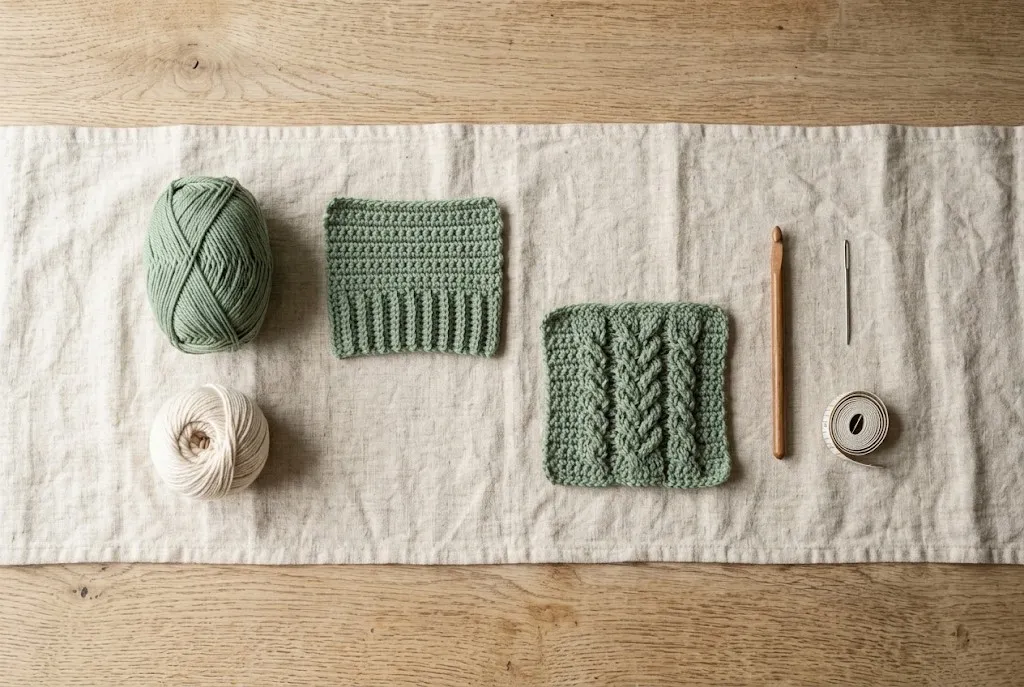
| Single crochet ribbing | Elastic, pulls the hem in | Hems, cuffs, neckbands |
| Back loop only | Creates a visible ridge line | Texture and simple stripes |
Now the gauge worksheet, which is the part people actually use. Fill in your numbers the day you swatch, not the day you cast on.
| Measurement | Your swatch | Pattern says | Match? |
|---|---|---|---|
| Stitches in 4 in (10 cm) | |||
| Rows in 4 in (10 cm) | |||
| Finished chest, flat | |||
| Sleeve length |
A washed and blocked swatch tells you far more than a fresh one, and most first garments come out slightly larger than their chart for exactly that reason. Write the numbers down, compare them, then cast on.
Questions readers ask most
How do I crochet a sweater?
The order barely changes between designs. Swatch and check gauge, cast on the body, work it flat until the armhole, skip the armhole stitches, shape or join the neck, make two sleeves, seam, then block. Learn those moves on something small, like a baby sweater or a sweater scarf, and the adult version stops feeling risky. Every free crochet sweater pattern in this round-up follows that order.
How do you crochet a pullover sweater?
The same as a sweater, with one difference: no front opening. You work the body in one piece or two panels, add the neck, then the sleeves. With no band and no button row, a pullover is the kinder first garment, and most of the free crochet sweater patterns here are pullovers. Search for an easy crochet pullover pattern only after your first one is blocked.
Which stitches do free crochet sweater patterns use most?
Single crochet, half double, double, and some form of ribbing for hems and cuffs. The taller stitches drape better, so they show up in adult designs more often than baby ones. If those four still feel shaky, practice them on flat squares first. That part is the same for beginner crochet sweater patterns free for anyone starting out.
Can I crochet a dog sweater the same way?
Yes. The construction is identical at a much smaller scale, usually in chunky yarn, so the free crochet sweater patterns above translate well once you halve the hook size. Measure your dog’s chest while they are standing rather than sitting, and leave room to move without the neck rubbing. Use a chew-resistant yarn and skip any decoration they could swallow. A dog sweater also forgives mistakes, since fur hides them.
How do I pick the right size in a free crochet sweater pattern?
Use the finished chest measurement in the pattern, not the size label. Measure a sweater you already like, compare the numbers, and if you land between two sizes take the roomier one for a relaxed fit. Between two yarn weights, the lighter one is kinder to a beginner. Charts assume average tension, and average tension is not you.
Where to start
Start with a pattern from the first group, not the last. Most of these free crochet sweater patterns need a handful of stitches and an honest swatch, and the quickest way to get good at crocheted clothing is to finish one simple thing in a weekend.
If a garment feels like too much yet, work smaller. Our crochet patterns for beginners guide has fifteen short projects that build the same skills, an easy market bag still teaches gauge and finishing, and our C2C guide covers reading a chart for the textures in the harder designs. Come back to the sweaters once you have one blocked piece behind you, and the free crochet sweater patterns on this list will be much easier.